

Age Categories
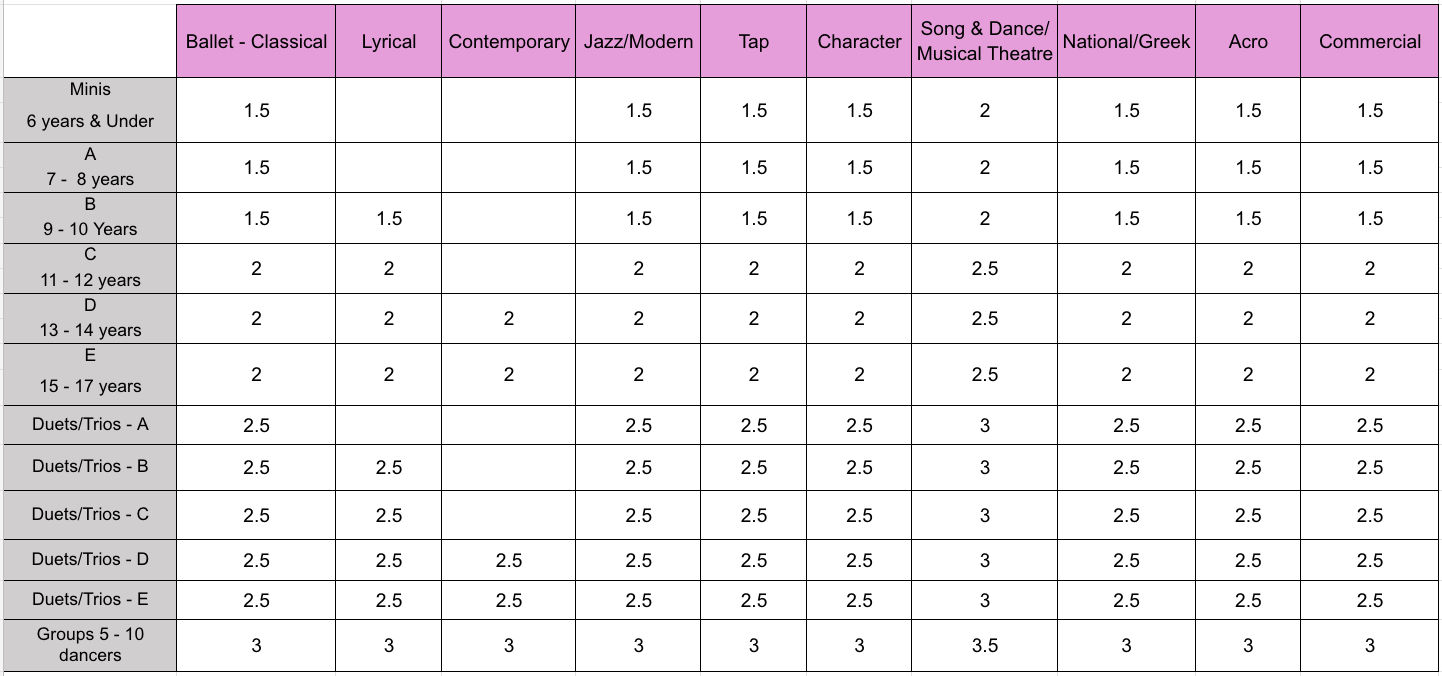
Our age categories for the festival are split into six age groups:
Minis – 6 years and under (minimum age 3 years)
A – 7 – 8 years
B – 9 – 10 years
C – 11 – 12 years
D – 13 – 14 years
E – 15 – 17 years
Ages are taken from the 31st August 2025
Each performer can compete as a Solo, Duet, Trio or Group in their age category in each area of the syllabus.
Entry Fees
SOLOS
£8.00 per dance – 10 & Under
£9.00 per dance – 11 & Over
DUETS
£11.00 per dance – 10 & Under
£13.00 per dance – 11 & Over
TRIOS/QUARTETS
£15.00 per dance – 10 & Under
£18.00 per dance – 11 & Over
GROUPS
£25.00 per group (5-10 dancers)

Ballet
Ballet (Classical Ballet)
Classical Ballet should include elements of both adage and allegro. Stylised ballet is a communication of an idea through movement, danced with/without the use of hand props, and could reflect elements such as the Hornpipe, Spanish and Tarantella for example. The use of
classical repertoire is not allowed. Music should be drawn from the classical genre and be suited to the range of vocabulary steps utilised.
Criteria
Pointework may be used in the Inter Category provided they are technically proficient and are able to maintain the use of pointe throughout the routine.
Dancers should demonstrate the principles of classical ballet, which include secure posture and alignment, turn-out, weight distribution and placement.
A well-schooled port de bras is an essential component that should exhibit correct shaping, flow, and coordination of the head and eye line.
Attention should be paid to the grouping of fingers and relaxation of the hands.
Ballet (Modern Ballet)
Contemporary Ballet is a fusion of both classical and modern ballet styles which may or may not be danced with a parallel line of the leg. Choreographers such as Crystal Pite or Wayne McGregor are examples of the type of work we would expect to see in this section, neo-classical work would also be acceptable. Music choices could be more varied and draw from a wider body of material than is suggested for classical ballet performances.
Criteria
Evidence of a secure ballet technique should be demonstrated but displaying freedom and articulation of the spine, moving away from the traditional classical lines, is encouraged.
Choreography should draw from both styles of dance exploring elements and pushing boundaries where these two techniques meet.
Floor work may be incorporated.

Tap encompasses many different styles – often dictated by the choice of accompaniment. The
use of the body and/or arm lines and overall performance should work in unity to form a
cohesive presentation that is informed by the style of tap that has been utilised. Tap dances
should be rhythmic, show clearly defined rhythmic patterns and precision in beating and
footwork. There should be variance in the use of tonal quality which may, or may not, be
influenced by the accompaniment.
Criteria
Stylistic interpretation and use of the body as a whole.
Timing and musicality.
Tonality and use of light and shade.
Clarity of beating and articulation of footwork.

Classical Greek
Classical Greek is performed barefoot and is essentially showing the use of opposition and relaxation through the movement.. Dances should reflect the title. Myths, studies from nature
and modern-day themes are acceptable, together with the accompaniment of many different genres of music or the spoken word, provided the movements are given their appropriate interpretation and relate to one or more of the seven styles of this technique. The choreography should be based upon the natural movements of the body such as Standing, Walking, Running, Skipping, Leaping, Jumping and Spinning, whilst experiencing the cultural connections to other arts such as Sculpture, Ceramics, Painting, Poetry, and Music. Aspects of the performance should include expression, use of breath and musical understanding. Also demonstrated should be balance, strength & control, relaxation, elevation, and flexibility through the spine.
Criteria
A connection and response to the chosen music, words or sound should be
demonstrated.
The dancer should demonstrate the correct technical and artistic requirements for the relevant styles: lyrical, athletic, bacchic, pyrrhic, tragic, choric and ritual.
The use of breathing, weight and relaxation and full use of the body should be evident throughout. The use of the spine, body turn, and precision of line should be secure.
The quality of the movement dynamics should match the chosen style, whilst showing fluidity and sensitivity where relevant.
National/Global
All traditional music, songs, and techniques appropriate to the country of choice are acceptable. Younger competitors are expected to demonstrate traditional performances. Seniors may introduce theatrical performances that are clearly based on a national tradition. The choice for this section is broad and encompasses both traditional folk dances and dances drawn from the rich body of cultural dance practices from around the world.
Criteria
The musical choice should incorporate the spirit of the country but doesn’t have to be a traditional folk piece.
Deliver a performance which captures the essence of the chosen country.
Footwork and body movements should have an authentic feel with the arms coordinating in the correct style.
A theme maybe used but is not compulsory and small props which help to create an authentic story can be incorporated into the performance.
The floor patterns and choreography should mirror those used in the chosen area (as appropriate to the specific region/style).

Modern/Jazz
Jazz utilises the underpinning of a clear jazz technique in its presentation. There is plenty of
scope for freedom in the style, choice of music and theme, if relevant. The term, theatrical jazz,
refers to the fundamental jazz dance techniques which evolved from musical theatre into more
contemporary hybrids such as modern dance and which may incorporate influences from
contemporary dance. The term Theatre Jazz does not dictate that the source material must be derived from musical theatre and the two should not be confused (although it is clearly
permissible to use this style in the genre). Choreography should reflect the rhythms and
dynamics of the music, clear sustained technique in turns, kicks and elevated steps and should avoid being solely based on limbering movements. Tricks can be utilised, but should have purpose to the piece, ensure that focus and consideration is given on the linking steps in
between to help with flow in the transitions.
Criteria
Stamina and consistency in performance.
Clarity of line through the limbs and body.
Control in technique (turns, kicks, elevation).
Use of dynamics and rhythmicality.

Lyrical Jazz
Lyrical Jazz allows the dancer to interpret the music and lyrics through movement and encourages a sense of musicality and connection between the dancer and the accompaniment. The use of breath is important and strong technical application will allow for
simplicity and space in the presentation. Highlights in the movement should match that of the orchestration/musical arrangement. Lyrical jazz is a pure interpretation of the music and should therefore show fluidity, resistance,
suspension, relaxation, purpose and create physical shapes that are aesthetically pleasing. Vocal or non-vocal music may be utilised, however if interpreting the lyrics, the performance should be consistent throughout. The choreography should have a continuous sense of flow showing breadth, expansion, and release. Whilst the use of floor work is permitted, it should be kept to a minimum. Ask yourself, does the music suggest going to the
floor? Music should be age appropriate and the size of orchestration and emotive content should relate to the age and ability of the dancer.
Criteria
Acrobatic work is not permitted in lyrical.
The dancer should demonstrate a sustained technique, extension, and continuity of line where relevant and fluidity in the movement.
The music should be embodied fully within the performance and the two elements should work in harmony with one another.
A range and richness in dynamics should be ever present in the work.
Throughout, the use of space and freedom in the movement should be evident.
The emotive response should come within and not be forced or contrived.
Contemporary
Breath should inform movement, with weight, swing, suspension, and release applied. Choreography should explore themes and the use of contraction, extension, and relaxation should be explored along with the use of the spine. The performance should avoid being presentational and dancers should demonstrate they have a deep understanding of what initiates movements and why. The space should be explored in a multi layered way including, levels, planes, and facings.
At its core the work should demonstrate a clear underpinning of recognisable contemporary dance techniques (such as Graham, Cunningham, Horton, Release) which may be amalgamated. However, the choreography should not be a hybrid of modern theatrical dance, which is not contemporary dance in its purest form.
Criteria
Clear initiation of movement is essential.
The work should be rooted in Contemporary Dance techniques.
Theme and/or choreographic devices should be apparent in the presentation of the work.
A sequential use of the spine should be clearly understood.

Musical theatre encompasses the ‘triple threat’ abilities of performers and adjudicators will consider the following aspects:
Vocal ability and technique.
Acting through song and connection to the words.
Acting through dance and/or movement.
The choice of the material should be both suitable in terms of age and cultural identity. Characterisation and believability are integral to the performance, and it is important
that the song choice is relevant to the performer. The lyrics are important, and clarity of diction should be thought about. Breath control and pitching are also a key element and need suitable training. The key of the accompaniment should be within the range of the performer and it is permissible to change this to suit the voice type. Dance should not be included for the sake of it and should flow naturally out of the lyrics and characterisation. Pedestrian movement and staging are considered appropriate, and each action should have a clear purpose and intention. Any genre of dance can be utilised, the focus should be that the genre enhances the role that is being played and is in keeping with the character and era of the chosen material. Ensure that the performer understands the context, period, and location of the song and/or musical.
Criteria
Suitability of the song choice to age of performer.
Vocal placing and pitching.
Characterisation and connection to the words.
Appropriate use of movement and/or dance.
Understanding the context of the piece.
For younger candidates in Minis and Junior sections, it is acceptable for the performers
to choose songs that are not necessarily drawn from musical theatre.
THERE IS NO REQUIREMENT FOR THE PERFORMANCE TO CONTAIN 50% SONG AND
50% DANCE.

Narrative/Character
In this section you may portray a character, fictional or non-fictional, or you may choose to interpret an animal or an element from nature, a feeling, an emotion or something more abstract. The fundamental element of the performance should always be focused on the storytelling and development of the narrative. Demi-character could be presented within this section.
Criteria
We would normally expect a classical genre to be utilised for this section, however on the odd occasion other forms of dance may be used if they aid the characterisation. The technique must be consistent throughout and appropriate to the piece as a whole. The chosen dance technique MUST serve the purpose of storytelling, a hybrid and creative utilisation of different dance techniques will be accepted.
The acting skills and an ability to communicate using the whole body should be visible throughout. The performance must be visceral.
The character should be expressed through body and facial expression with a clear sense of purpose behind the movement.
 Itchen Dance Festival